
From Lewandowski to Osimhen: Stars Missing the World Cup
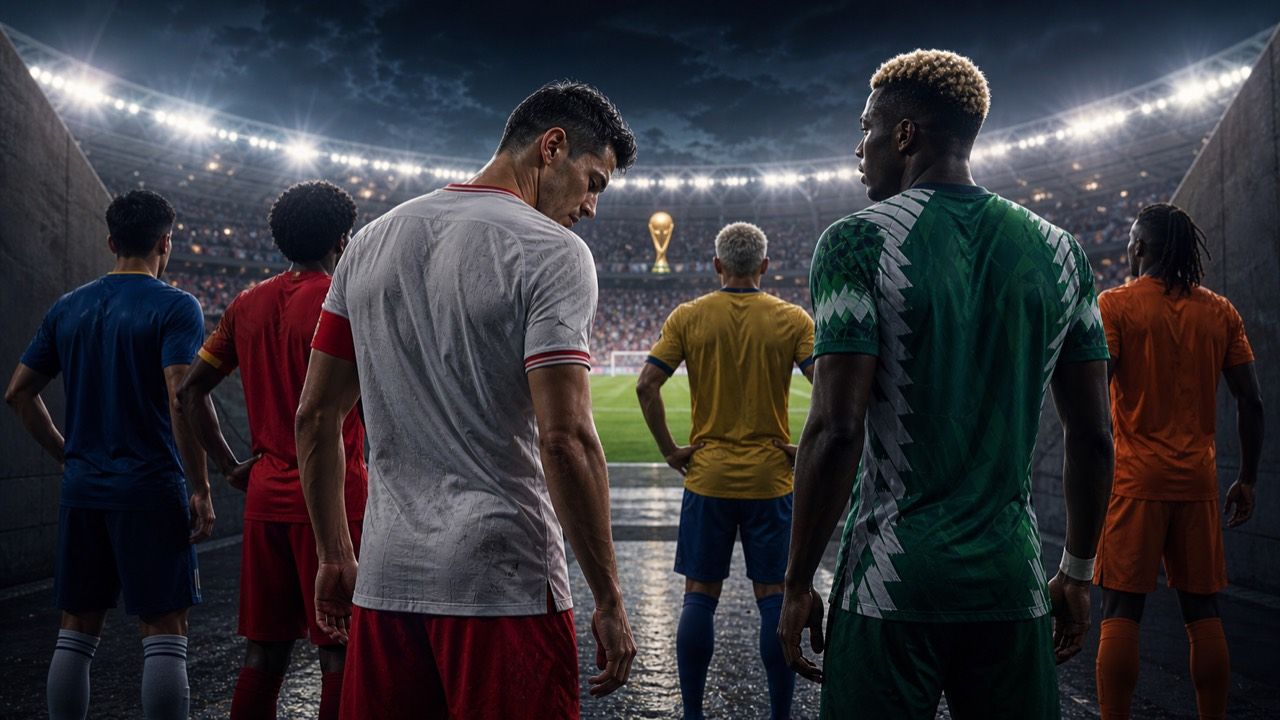
The 2026 World Cup has expanded to 48 teams, but several major stars are still absent. Robert Lewandowski, Victor Osimhen, Gianluigi Donnarumma, Sandro Tonali, Khvicha Kvaratskhelia, Dusan Vlahovic, Rasmus Hojlund, and Bryan Mbeumo headline the missing list.
The World Cup is never only about the players who make it. It also creates a shadow list of stars left outside the tournament. Even with the 2026 World Cup expanded to 48 teams, several elite footballers will still watch from home. Robert Lewandowski, Victor Osimhen, Gianluigi Donnarumma, Sandro Tonali, Khvicha Kvaratskhelia, Dusan Vlahovic, Rasmus Hojlund, and Bryan Mbeumo are among the biggest names missing from this edition.
For this group, the main reason is national-team failure rather than individual ability. Poland, Italy, Nigeria, Georgia, Serbia, Denmark, and Cameroon did not reach the final tournament, taking their stars with them. There are always personal factors around injuries, form, and squad selection, but with these eight players the bigger story is the same: a world-class or high-level club career does not guarantee a World Cup place.
The most important case is Lewandowski. He has played in two World Cups, Russia 2018 and Qatar 2022. In 2018, Poland went out in the group stage and Lewandowski did not score. In 2022, he finally got his first World Cup goal, helped Poland reach the round of 16, and also scored in the knockout defeat to France. For a striker who dominated club football for more than a decade, the World Cup has always been the one stage he never fully conquered.
That is what makes his absence so heavy. Lewandowski has won The Best FIFA Men's Player twice, lifted the Champions League with Bayern Munich, collected multiple Bundesliga titles, and won European Golden Shoe honors. He is Poland's all-time leading scorer and one of the most reliable centre-forwards of his generation. But World Cup football gave him only limited room to build a legacy. Poland's failure to qualify for 2026 may have removed his last realistic chance to add another chapter.
Osimhen's absence is painful in a different way. He has still never played at a senior World Cup. Nigeria reached the 2018 tournament, but Osimhen was not in the final squad; Nigeria missed 2022 and are absent again in 2026. At club level, his resume is already strong. He helped Napoli win the 2022-23 Serie A title, scored 26 league goals to finish as Serie A top scorer, and was named African Footballer of the Year in 2023. He also won the 2015 FIFA U-17 World Cup and finished as that tournament's top scorer. The senior World Cup, however, remains missing.
Italy's absence creates another kind of gap. Donnarumma has never played at a World Cup because Italy have now missed 2018, 2022, and 2026. That is extraordinary for a goalkeeper who already owns one of the biggest national-team moments of the decade. At EURO 2020, he helped Italy win the title and was named Player of the Tournament by UEFA. A European champion and tournament MVP with no World Cup appearance is one of the clearest symbols of Italy's modern slump.
Tonali is part of the same Italian problem. He also has no World Cup appearance. He was one of the most important midfielders in AC Milan's 2021-22 Serie A title run and later moved to the Premier League. For Tonali, missing the World Cup is not only a blank line in his own record; it is another lost tournament for Italy's current midfield generation. Italy still produce serious talent, but three straight missed World Cups have denied that talent the platform it should have had.
Kvaratskhelia's case is different because Georgia have never been a World Cup regular. He has no World Cup appearance, but his club impact has already changed the way the football world sees Georgian talent. In 2022-23, he helped Napoli win Serie A and earned league MVP-level recognition. Georgia have shown they can produce tournament drama in Europe, but the World Cup remains a higher barrier. His absence removes one of football's most entertaining wide attackers from the 2026 stage.
Vlahovic is one of the few names here with previous World Cup experience. He played at the 2022 World Cup with Serbia, scored against Switzerland, and exited in the group stage. Serbia had attacking talent in Qatar, but not enough defensive stability or game control to advance. Vlahovic remains one of Europe's most physically imposing finishers, and missing 2026 denies him a second World Cup chance at a more mature point in his career.
Hojlund has not yet played at a World Cup. Denmark were at the 2022 tournament, but he was not in the final squad. Denmark's failure to reach 2026 means his wait continues. His club career is still developing, but he has already played for Atalanta and Manchester United and won the 2023-24 FA Cup. Compared with Lewandowski and Osimhen, Hojlund's World Cup absence feels more like a delayed opening than a closing window. Still, for a young striker, missing one World Cup removes a major global showcase.
Mbeumo has already been to a World Cup. He represented Cameroon in 2022 and appeared during the group stage, but Cameroon did not reach the knockouts. Their absence from 2026 takes away his second chance. In the Premier League, Mbeumo has become a mature and flexible attacker who can play wide, press aggressively, counter at speed, and operate closer to goal. Cameroon missing out means the tournament loses a player well suited to the rhythm of World Cup football.
If one player defines this list, it is still Lewandowski. Osimhen represents the prime striker still waiting for his senior World Cup debut. Donnarumma represents the European champion with no World Cup stage. Kvaratskhelia represents the lonely star from a smaller football nation. But Lewandowski represents something more layered: a nearly complete club career that never received an equally large World Cup chapter.
That is the brutal nature of the World Cup. It does not gather the best players in the world; it gathers the best qualified national teams. Individual awards, club trophies, league scoring titles, and European Championship glory cannot guarantee a ticket. The missing stars of 2026 are a reminder that some footballers do not lose to talent. They lose to pathways, team context, and the unforgiving gate of qualification.
- Robert Lewandowski, Poland: 2 World Cups. 2018 group stage, 2022 round of 16. Major honors include The Best FIFA Men's Player twice, Champions League winner, European Golden Shoe, and multiple Bundesliga titles.
- Victor Osimhen, Nigeria: 0 World Cups. No senior World Cup appearance. Major honors include 2023 African Footballer of the Year, Serie A champion, Serie A top scorer, and U-17 World Cup winner/top scorer.
- Gianluigi Donnarumma, Italy: 0 World Cups. No World Cup appearance. Major honors include EURO 2020 winner, EURO 2020 Player of the Tournament, and Yashin Trophy.
- Sandro Tonali, Italy: 0 World Cups. No World Cup appearance. Major honor: 2021-22 Serie A champion.
- Khvicha Kvaratskhelia, Georgia: 0 World Cups. No World Cup appearance. Major honors include 2022-23 Serie A champion and Serie A MVP-level recognition.
- Dusan Vlahovic, Serbia: 1 World Cup. 2022 group stage, 1 goal. Major honors include Coppa Italia and other club honors.
- Rasmus Hojlund, Denmark: 0 World Cups. No World Cup appearance. Major honor: 2023-24 FA Cup winner.
- Bryan Mbeumo, Cameroon: 1 World Cup. 2022 group stage. Premier League standout and key Brentford promotion-era attacker.
- FIFA: Lewandowski on his first World Cup goal
- UEFA: Donnarumma named EURO 2020 Player of the Tournament
- ESPN: Osimhen named African Footballer of the Year
Discover More
View All
The German Machine Still Has Its Power
Germany opened their 2026 World Cup campaign with a 7-1 win over Curacao, combining high pressing, wide overloads, strong chance creation, and ruthless finishing.
Jun 15, 2026
Japan Charge Relentlessly and Look Every Bit as Strong as a European Power
Japan's 2-2 draw with the Netherlands showed why the Samurai Blue can stand toe to toe with elite European opposition, from the pre-match numbers to the transition bursts, score swings, and what comes next.
Jun 15, 2026